EconoScope | 'Chinamaxxing' reshapes inbound travel to China_我的网站
A |
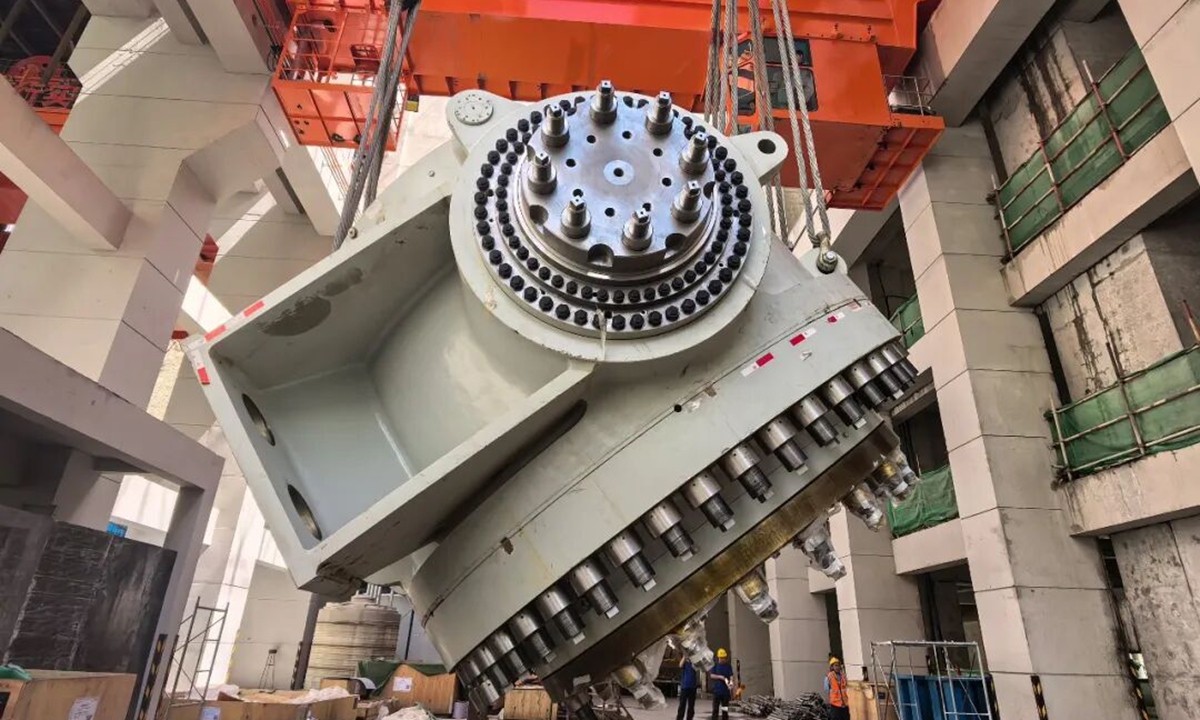
A view of the inlet spherical valve for Unit 1 at Zhala Hydropower Station. Photo: Screenshot from Dongfang Electric Corporation's Wechat account The world's largest impulse hydropower unit successfully completed its rotor hoisting at the Datang Zhala Hydropower Station in Southwest China's Xizang Autonomous Region on Tuesday, the CCTV News reported. The milestone marks China's entry into the world's leading ranks in innovating core technologies for ultra-high-head, large-capacity impulse hydropower equipment, which will support the development of clean energy in southeastern Xizang. The Datang Zhala Hydropower Station is a major national project for transmitting electricity from Xizang to other regions. It is equipped with two 500-megawatts impulse units, the largest single-unit generator of this capacity globally, which features technological advantages such as high altitude, ultra-high head, and large capacity. The project is also the first approved megawatt-level hydropower project in Xizang and a key power source for China's national-level clean energy demonstration base integrating hydropower, wind, and solar resources in southeastern Xizang region, according to media reports. The rotor hoisted on Wednesday is the "power heart" of the generator that enables energy conversion. Weighing about 840 tons, equivalent to the total weight of 560 sedan cars, its successful installation marks the final sprint phase before the project goes into commercial operation, the report said. Once fully operational, the hydropower station will generate nearly 4 billion kilowatt hours of clean renewable electricity annually, saving 1.3 million tons of standard coal and reducing carbon dioxide emissions by 3.42 million tons. The Datang Zala Hydropower Station is located on the Yuqu River, a tributary of the Nu River, which flows from Southwest China's Yunnan Province to eastern Myanmar and empties into the Andaman Sea. 。 (ECNS) -- "Chinamaxxing," a social media buzzword describing immersion in all things Chinese, is reshaping inbound tourism as more international visitors move beyond sightseeing to embrace culture, technology and daily life. Jin Zhun, associate research fellow at the National Academy of Economic Strategy, said the rapid emergence of terms like "Chinamaxxing" reflects the growing range of experiences available in China and signals that China travel is becoming a global trend.
(Screenshot from YouTube)
According to data from the National Immigration Administration (NIA), more than 22.91 million foreign nationals entered China in the first half of 2026, up 20.4% year on year. Of these, 17.815 million entered visa-free, accounting for 77.7% of all foreign arrivals. NIA said that the top 10 source countries for inbound foreign travelers were South Korea, Russia, Malaysia, Vietnam, Thailand, Singapore, the United States, Japan, Mongolia and Australia. Inbound spending has surged. Alipay data shows tourist consumption rose 72.9% year‑on‑year since June. Shanghai customs processed 253,000 departure tax refund applications in H1, nearly triple last year, with refunded goods worth 23 billion yuan ($3.2 billion). Rather than simply checking destinations off a list, visitors are tailoring traditional outfits, picking spring tea leaves, or joining locals for early‑morning Baduanjin exercises in parks. Tech tourism is also booming: NEV factories have welcomed more than 250,000 visitors since opening to the public in 2024, while humanoid robot performances and rocket launches at Wenchang have become highlights for overseas travelers. As The Guardian observed, China is sending a clear message: Come here and judge China for yourselves. From "China Travel" to "Chinamaxxing," the evolution of these buzzwords reflects a broader shift in how foreigners perceive China. Instead of viewing the country through online content alone, more people are choosing to experience it firsthand and form their own impressions. (By Gong Weiwei) 。
Current article:http://apvy.diapoqiechuangpenghua.sbs/kj6s7i/20260826/3970.html



 。
。 金融监管总局:对恒大人寿保险有限公司吊销业务许可证,金融监管总局:对恒大人寿保险有限公司吊销业务许可证
 无缘首冠,张帅“不遗憾也不意外”
 火药味拉满! 76人记者:东部或现30年最强赛季
 Rajnath launches dedicated portal to support kin of fallen heros
 100吨超大推力电动振动试验系统研制成功
 英伟达财报前瞻:AI霸主的业绩或将成为下一阶段整个板块的市场指引
 केमिकल से भरे टैंकर में लग गई आग, फिर भी हाईवे पर तेज रफ्तार में चलती रही गाड़ी; ड्राइवर ने कूदकर बचाई जान
 湖北一5岁女童看表演被机器人踢掉4颗门牙,面部缝3针,事发9个月与之前事方仍未谈拢


